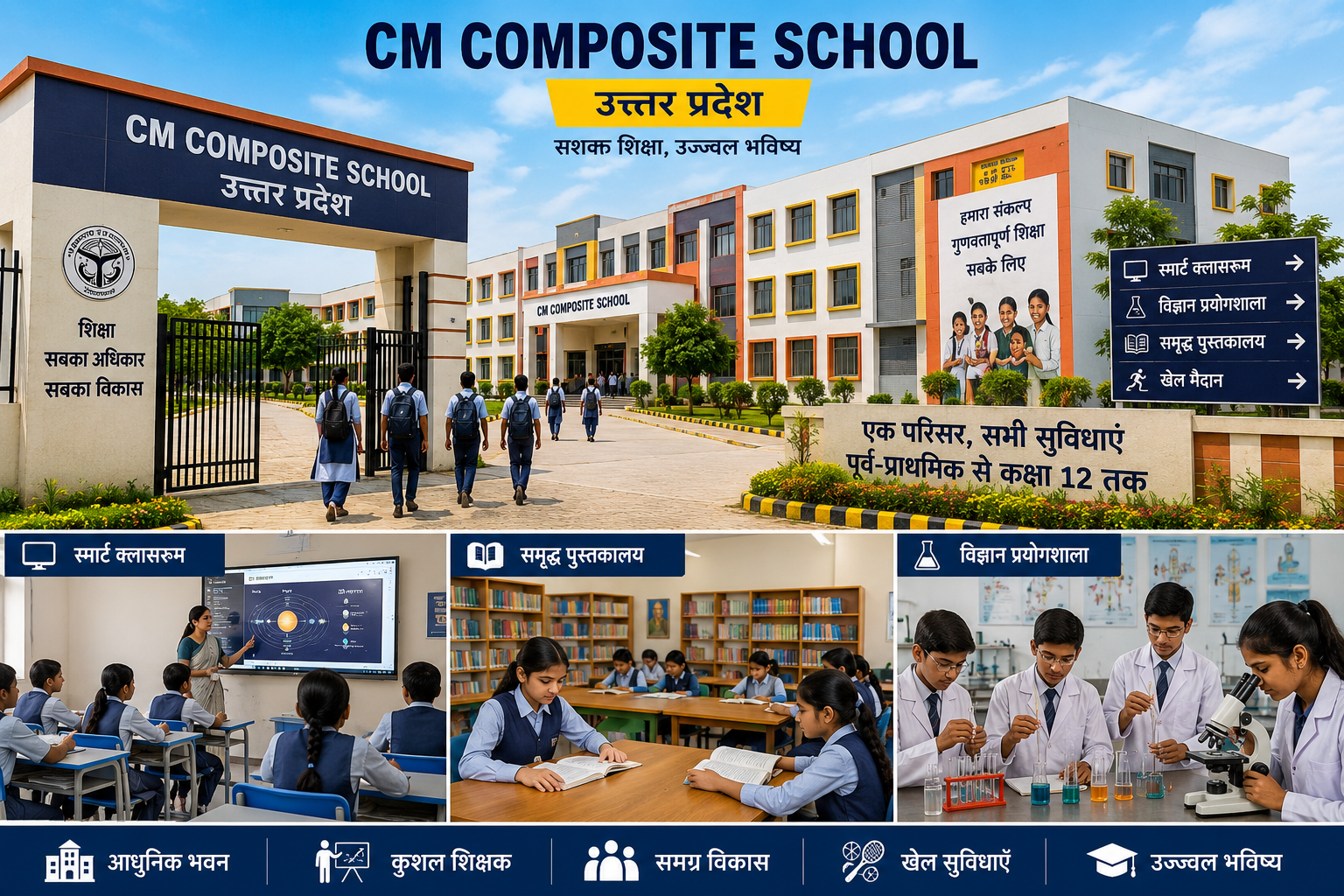
Lucknow: In a major education reform initiative, the Uttar Pradesh government is set to establish state-of-the-art CM Composite Schools across the state, aiming to provide world-class education comparable to leading private and convent schools at a nominal cost. The ambitious project is designed to ensure that children from economically weaker and rural families have access to high-quality education without the burden of expensive school fees.
The initiative is part of the Yogi Adityanath government’s broader vision to transform the image and quality of government schools while aligning education with the needs of the 21st century.
Smart Classrooms, Robotics Labs and Digital Learning
The proposed CM Composite Schools will feature modern infrastructure, including smart classrooms, digital libraries, science laboratories, and robotics labs. Students will also receive exposure to emerging technologies such as Artificial Intelligence (AI), coding, and digital learning tools.
To ensure high educational standards, professionally trained teachers will be recruited and existing educators will undergo screening and specialized training. Officials say the overall environment and facilities will be comparable to those found in top private institutions.
Education from Nursery to Class 12 Under One Roof
One of the key features of the project is the integration of all levels of schooling within a single campus. Unlike the current system, where students often move between primary, upper-primary, and secondary schools, CM Composite Schools will provide continuous education from pre-primary (nursery) to Class 12.
The model is expected to offer greater academic continuity and reduce disruptions in students’ educational journeys.
₹4,500 Crore Budget Allocated
The state government has earmarked approximately ₹4,500 crore for the project. Initially, plans are underway to establish two CM Composite Schools in every district, with future expansion proposed at block and Nyaya Panchayat levels.
Construction work has already commenced in 39 districts during the first phase, with admissions targeted to begin by March 2027 and academic sessions scheduled to start in April 2027.
English-Medium Education Under NEP 2020
The schools will operate in accordance with the National Education Policy (NEP) 2020 and offer English-medium instruction. However, unlike many private institutions, the schools will remain affiliated with the Uttar Pradesh Board rather than the Central Board of Secondary Education (CBSE).
The curriculum will focus on experiential and practical learning rather than rote memorization, encouraging critical thinking, innovation, and skill development among students.
Modern Laboratories and Language Centres
Separate modern laboratories for Physics, Chemistry, and Biology will be established for senior students, while younger learners will have access to modular science and mathematics labs designed to make learning more interactive.

The schools will also feature language centres where students will learn English, Hindi, and Sanskrit. In a unique initiative aimed at preserving cultural heritage, regional languages such as Awadhi, Braj, Bundeli, and Bhojpuri will also be taught.
Audio-visual technology will be used to improve pronunciation, vocabulary, communication skills, and overall language proficiency.
Focus on Skill Development and Coding
Along with academic excellence, the schools will emphasize skill development and employability. Students will receive coding education and practical exposure to technology-based learning. Authorities believe this approach will better prepare students for future academic and professional opportunities.
Mid-Day Meals, Medical Facilities and Student Safety
The Mid-Day Meal Scheme will continue in CM Composite Schools. A modular kitchen and dedicated dining hall will cater to approximately 1,300 students from pre-primary to Class 8.
Student welfare has also been prioritized through the inclusion of a fully equipped medical room featuring beds, oxygen cylinders, stretchers, and first-aid facilities. Students will receive basic training to respond to emergency situations.
For enhanced security, campuses will be monitored through CCTV surveillance systems linked to centralized control centres.
Affordable Fees and Direct Benefit Transfers
Perhaps the most significant feature of the initiative is affordability. The schools will charge only nominal fees, similar to the model followed by Kendriya Vidyalayas.
Additionally, financial assistance for uniforms, school bags, and footwear will be provided directly into students’ bank accounts through the Direct Benefit Transfer (DBT) system.
Admissions will be conducted annually in March through a merit-cum-lottery system, with priority given to students from rural areas and economically disadvantaged families.